Product Description
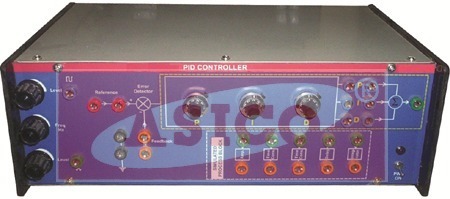
PID CONTROLLER
- Study of an simulated PID controller.
- PID Controller (configurable as P, PI, PD and PID).
- Proportional band : 1% to 50%. Gain : 0-20.
DESCRIPTION
This set up is designed to study performance of analog PID Controller with simulated process. The board has built in signal source, building blocks for simulated process and PID Controller with built in regulated dc supply to operate the system.
The PID Controller has three adjustable parameters, as P, I, D each has 10 turn potentiometers with dial knobs which are subdivided for .02 resolution. Three sockets are provided to add or out any of desired control P, I or D. at input of PID controller an adder is provided which sums the reference and feedback signals. The input and output of PID control has no phase shift.
TECHNICAL SPECIFICATIONS
- Study of an simulated PID controller.
- PID Controller (configurable as P, PI, PD and PID).
- Proportional band : 1% to 50%. Gain : 0-20.
- Integral time : 10 mS 100 mS.
- Derivative time : 2-20 mS.
- Signal sources :
- Square wave, Triangular Wave : 0-2Vpp at 10-40 Hz variable (typical).
- Built in IC regulated power supplies.
- 220V ±10%, 50Hz mains operated.
- Users Manual with patch cords.
LIST OF EXPERIMENTS
- Study of open loop response of various
- Study of close loop response.
- P, PI & PID design and performance evaluation in each case.
Versatile Universal Inputs and OutputsThis PID Controller supports a wide array of input signals, including RTD, thermocouples, mA, and voltage. The multiple control output optionsrelay, SSR, and analogmake it compatible with diverse industrial applications. Whether you need basic control or advanced automation, this device adapts with flexibility.
Advanced Control Accuracy and FeaturesAchieve highly stable process regulation with PID control, a sampling rate of 100 ms, and resolution options of 0.1C or 1C. The controller provides a 0.5% full-scale accuracy. Dual programmable alarms enhance operational safety, while multiple set point options meet highly specific process demands.
Robust Design and Seamless IntegrationBuilt with a durable ABS plastic enclosure, this controller withstands harsh environments. Its compact form and panel mount design simplify installation. With RS485/Modbus communication, integration into industrial systems is straightforward, supporting real-time data exchange and remote monitoring.
FAQs of PID Controller:
Q: How does the PID controller maintain precise temperature control in industrial processes?
A: The controller employs Proportional-Integral-Derivative (PID) algorithms, continuously adjusting output based on feedback from universal input types like RTD or thermocouple. This ensures stable, accurate temperature regulation with minimal fluctuation and a resolution as fine as 0.1C.
Q: What are the benefits of using dual programmable alarms on this PID controller?
A: Dual programmable alarms allow users to set independent safety thresholds for critical process parameters. This provides early warnings or automated actions in case of deviations, helping prevent equipment damage, product loss, or unsafe conditions.
Q: When should I select relay, SSR, or analog output control?
A: Choose relay output for basic on-off control of devices such as heaters, SSR for silent and reliable switching with solid-state relays, and analog output for proportional or precise control of actuators and variable devices within automation systems.
Q: Where can this PID controller be installed and used?
A: Designed for panel mounting, it is ideally deployed in control cabinets across various industrial settingsmanufacturing plants, process lines, and automation panels throughout Indiawhere accurate process regulation is required.
Q: What process do I follow to configure the set point and alarms?
A: Use the intuitive LED display and keypad to input desired set point(s) and alarm thresholds. Programming is straightforward, enabling quick setup of single or multiple set points and custom alarm values to suit your process requirements.
Q: How does RS485/Modbus communication enhance usage?
A: RS485/Modbus connectivity allows seamless integration with SCADA, PLCs, and other industrial automation devices, enabling centralized monitoring, remote adjustments, and real-time data logging for enhanced process efficiency and oversight.